
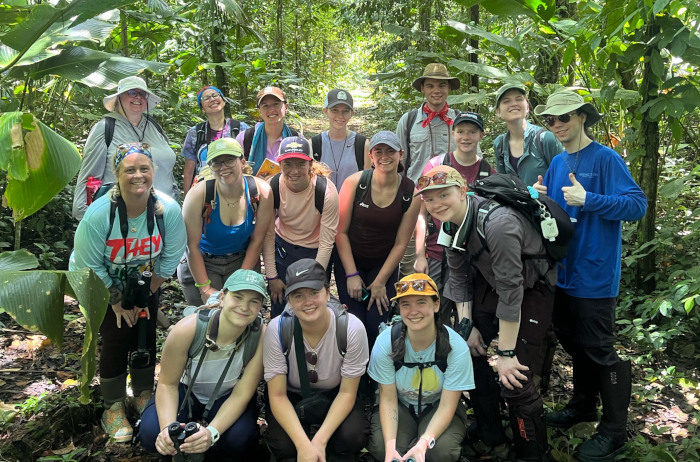
Every year, Ana Estrella, Department Chair of Natural and Applied Sciences at Missouri State University-West Plains, leads a group of students on a trip to Costa Rica as part of the Education Abroad program. The experience is also open to community members.
In May 2025, Alexandra Graham, Director of Assessment and Accreditation, joined the group traveling to Costa Rica for the Leatherback Sea Turtle Expedition. Inspired by her journey, Graham wrote a travelogue detailing her experience. The following is in her own words:
Leatherback Sea Turtle Expedition Travelogue

Written by: Alexandra Graham
Director of Assessment and Accreditation
Full disclosure: I didn’t ask any questions about what I agreed to when I said yes to chaperoning for The Expedition: Leatherback Sea Turtle and Tropical Ecology from MSU Education Abroad. I said yes and decided to sweat the details later. So I was mightily surprised in April when I went to the planning meeting to find out about the packing list, what we were going to do, how much walking was involved, where we were going to be staying, etc. I’m not going to lie, I seriously wondered if I was going to be able to hack it at age fifty, and if everyone else on the trip was thinking to themselves, “The physical requirements on this trip were explained, why did she come if she can’t do it?” Nonetheless, there I was at 3:30 a.m. at Springfield Branson Airport getting ready to go on our adventure.
Arriving in San Jose
Standing in line at customs in San Jose, Costa Rica, we were not the only college study-abroad group. It was clear they were going on a very different trip than us. These other college groups rolled along their matching Louis Vuitton hard-sided luggage, in full makeup and hair, mugging for their cameras:
“We are here in Costa Rica! (whoooo!) We are going to learn so much by going on snorkeling trips, touring a banana plantation, and eating delicious Costa Rican food! We will learn the national anthem to discover a deep appreciation of Costa Rican culture! Pura Vida!”
Then there was us: crunchy, granola, exhausted, all of us wearing our hiking boots, most of us carrying 35-pound camping backpacks and a separate day pack, looking like we were planning to do the 600-mile walk from one coast to the other coast. (Side note, one of our guides leads hiking groups during the regular season from coast to coast. He said it takes about two and a half weeks, and the hike includes going over two mountain ranges.) Once we got through customs, met our guides, and clambered into the 20-person van, we were off to our hotel.
The adventure begins!
The drive through San Jose is…not like the US. Clearly, no city planners laid out a nice, neat square grid of roads, with several lanes anticipating population growth. The most harrowing moment was when we were going up a hill that, I swear to God, was at a 70-degree angle, with trees on both sides encroaching on the road, and the car going down the hill next to us was so close she had to fold in the mirror to be able to pass us. (Also, our driver, Luis, was amazing at navigating traffic and the road conditions. He is as much a driving artist as he is a sculpture artist).
When we got to the hotel, we dropped off our stuff, had our first Costa Rican dinner (fish with rice and beans—so good), and then we met with our guides. At this meeting, we did some baseline activities to provide an idea about what we knew about Costa Rica before we came and surrender our phones for the duration of the trip.
Pacuare Reserve
Our first stop on the trip was to the Pacuare Reserve, which is beautiful and primitive. We did indeed have flushing toilets and cold showers, and we had beds in a bunk house and a kitchen cantina, but that was the end of the amenities. No electricity except for the kitchen generator. It was the kind of hot and humid that I laid still under the mosquito net and felt my pores releasing all the water in my body. In the mornings we woke up to the howler monkeys and the noisy cacophony of birds and insects. During the day, we hiked in the secondary rainforest and observed strawberry dart frogs, spider monkeys, toucans, and all kinds of other flora and fauna. We went to Parismina to learn about ecotourism, and we played all kinds of games to help us bond.
Hands-on Learning
In the night, we did the turtle census (the service-learning part of the program), which is the primary purpose of the education abroad. Based on the pictures advertising the trip, I thought “turtle census” meant we were counting baby turtles. That’s what the pictures show: cute baby turtles making their way to the sea in the sunrise with fresh-faced college students in the background smiling beatifically holding a clipboard.
Maybe that’s what the Louis Vuitton crowd’s college trips are about. Our turtle census was participating in authentic ongoing research to find Leatherback Sea Turtles in the process of laying eggs in the dead of night. To do this, we had two four-hour shifts: 8-1, 11-3, and we walked eight kilometers in the sand, in the dark (no flashlights because it might confuse the turtles), hoping to stumble on a turtle laying eggs. First of all, Leatherback Sea Turtles are enormous. Like, they’re as big as my 6’4” husband, and they’re about as strong.
While we were there, the turtle census measured a total of ten turtles in three days. When we found a turtle, the Research Assistant gave us directions to help dig the hole deeper, and assigned one student to be on her belly, arms outstretched, holding an enormous plastic bag in the hole under the turtle’s butt, catching the eggs as they dropped. Two other students measured the turtle’s neck. Two other students measured the turtle’s carapace. Two other students measured the turtle’s distance from the water and then from the sand cliffs. Then the research assistant checked if the turtle had already been tagged and added a tag to her rear flipper. A student recorded all the data as part of a huge research project to measure Leatherback Sea Turtle movements and egg laying numbers. The eggs are kept in a hatchery, and when they hatch, they are indeed released to the ocean. I don’t know if the research assistants smile beatifically at them or not, but that was going to happen a couple of months after we were gone.
Veragua Rainforest Research and Adventure Park
After Pacuare, we went to Veragua Rainforest Research and Adventure Park, which is in a mature rainforest in the mountains. The amenities here included hot showers and electricity, and Veragua is both a tourist spot and a site for research. Here we did a butterfly census, rode a gondola and hiked to a waterfall, but the most exciting part was seeing all the tree frogs and snakes on our night hikes. I had never even heard of an eyelash pit viper before, but I saw a bunch of them, along with some really great orb weaver spiders.
While we stayed at Veragua, we took a day trip to Cuahita, back on the coast, to snorkel on the coral reefs to see how the building of a new port and climate change affected the coral reefs. The coral was bleached, and I learned a lot about why that happens, but I saw a nurse shark! Getting me back into the boat was a comedy of errors—but everyone was so kind anyway. In the afternoon, we went to a cacao plantation and learned about how chocolate is made. It was fascinating to see the process from cacao growing on the plant to being edible in our hands, and I’m still kicking myself for not bringing home fresh cacao.
Back to San Jose
Our last night, we returned to San Jose to get our phones back. Based on my experience and what I heard from the students, the people most unhappy about the requirement to give up our phones were our parents and significant others. Honestly, it was great to have a full week of not knowing what was going on in the dumpster fire of a news cycle, and I heard a bunch of students say throughout our time how glad they were to be away from the drama of home. One student said, “Phones not being present allowed me to connect with the group much more quickly and painlessly than I had thought.” Another student commented, “This turned out to be a highlight of the trip for me. The world we have made is so full of distractions. This trip allowed me to rediscover the simple joys of life and existence.”
Opportunities and Obstacles
In terms of the best hits of the trip, most of my highlights involve quiet kindness and connection: out on the beach guarding turtle eggs, everyone’s excitement at seeing spider monkeys, seeing the research assistants and kitchen staff dancing to Justin Timberlake’s “Rock Your Body.”
For students, the data from the post survey was clear: Students rated the value of the program as much more valuable than what they would have received in an on-campus class.
According to students, the most desirable aspects of the program included:
- Seeing so many different species of tropical wildlife and rainforest ecosystems.
- The research, special trips, and getting to see the different lifestyle.
- Getting hands on field work experience.
- The program was packed full of a wide range of activities. Gave plenty of opportunities to learn hands-on skills and give insight into the lives of professionals in this field.
The lowlights of the trip were also largely quotidian for me. After a week, even I was tired of rice and beans. I will never take for granted the ability to flush my toilet paper again. In Veragua, I had wet pajamas because they didn’t dry as fast as expected. For students, the least desirable aspects of the trip included:
- Very primitive living conditions especially in Pacuare Norte; I’ve never eaten such large volumes of beans and rice in my entire life.
- Not knowing what to expect about the places we would stay.
- Even though I was exhausted, I wouldn’t remove anything from this program. It was all so new and exciting!
- The heat, but it’s Costa Rica–no changing that.
Student Feedback
To assess this trip, students took a pre-departure survey asking about their competency with other cultures, self-growth, and academic/professional growth. In every single metric, the post survey showed students felt more culturally competent, more self-confident, and had clearer future goals. Student comments included:
- We learned about Costa Rican lifestyle, food, communities, and conservation. Something I did not expect to learn about was the environmental and ethical concerns of banana plantations.
- I didn’t realize how different the transportation would be. It was odd seeing so many motorbikes, roads backed up for miles, and everyone being a relatively aggressive driver, but also seeing no evidence of wrecks or car damage. I expected to learn about the community, conservation, waste management, and overall attitude towards life.
- I was not prepared for how much food impacts their day-to-day lives. I also did not expect their infrastructure to look so much like LA. In the city, it was all fences, and in the country, it was all community.
- I expected to learn about their food, some bits and pieces of the language, and history regarding their ecotourism and sustainability — all of which I did learn. What I learned that I didn’t expect to was just how much the culture treasures harmony with nature. Though this was conveyed in their unofficial national slogan, I saw it in the art depicting wildlife, the way even urban areas in San Jose were teeming with plant life, and the numerous wildlife crossing signs I saw posted during bus rides.
Like the students, I learned a lot more than just the actual curriculum. Did I learn a lot about mature tropical rainforests and secondary tropical rainforests? Yes. Did I learn a lot about turtles, monkeys, birds, snakes, butterflies, frogs, etc.? Yes. Did I learn a lot about how industry impacts the environment and how Costa Rican culture balances those competing needs? Yes. All classes have a hidden curriculum—the stuff you get on the way to learning the stated purpose of the class. What I learned from the hidden curriculum is I have more physical and emotional grit than I have been expected to produce recently. I learned most people are a lot kinder than I am expecting them to be, and it made me reframe my expectations going forward. I reaffirmed the power of connection, and that’s something I want to bring with me wherever I go.
The deadline to apply for the next Costa Rica Education Abroad opportunity is Dec. 1. The application can be accessed online through the Missouri State University Education Abroad website, International.MissouriState.edu/EducationAbroad. Click on the “Search for a Program,” then “MSU Short-Term: The Expedition” links, then follow the directions to apply.
For more information about this opportunity or application procedures, contact Estrella at 417-255-7710 or AnaEstrellaRiollano@MissouriState.edu.